 Episode 2
· 17:30
Well, good morning, good afternoon, and good evening to all of you. My name
William Hocking:is Bill Hocking, and welcome to the one, the only Bill Hocking Podcast. Good morning, good afternoon, and good evening. Welcome yet again to the wild world of the William Hocking Podcast brought to you each week by podcaststhatmatter.org and podcastmatter.com. Today, our focus in our ongoing series of what it means to live a life worth living is on military service. Perhaps a controversial topic, depending on how you look at the military in today's world and lens, but we're gonna talk about it a little bit, and our guest today is someone I've known for about eight years now.
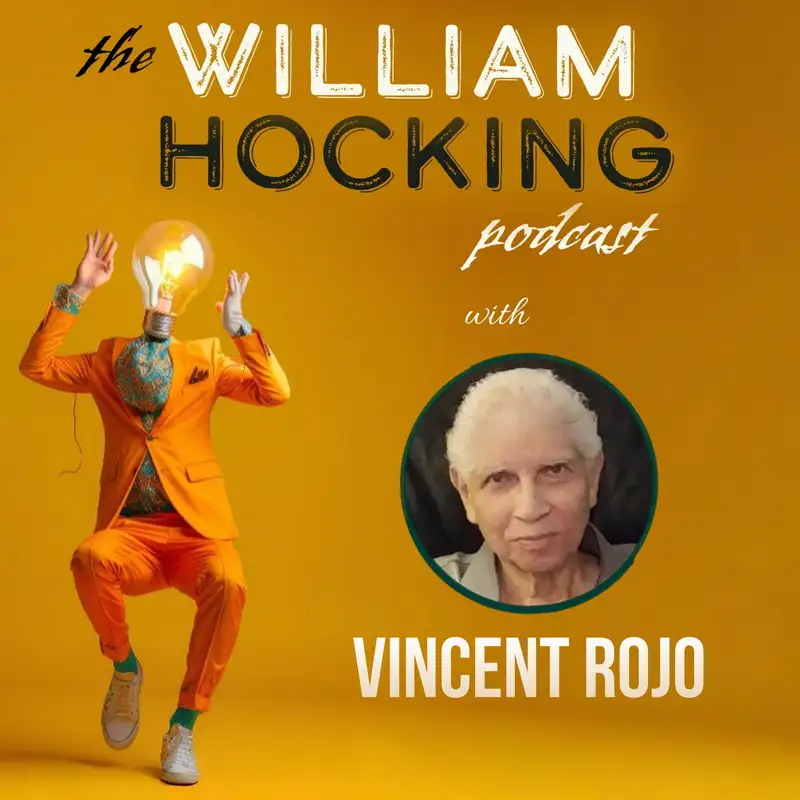
William Hocking:He's an older gentleman, believe it or not, he's older than I am. His name is Vincent Rojo. You can call him Vinny, everybody does. And Vinny is an Air Force veteran. So he and I are gonna be talking about his opinions on what today's military is doing well and what it's not doing so well as compared to what the Air Force looked like when he was wearing the uniform.
William Hocking:We're going talk a little bit about the sense of discipline, the sense of honor that existed when he was serving, and how he feels about those characteristics today. We'll talk a little bit about leadership, what that looks like to him as he sees it today or perhaps as he does not see it today, and again comparing to what he experienced when he was wearing the uniform. So please welcome Vinny to the stage. Here he is. Well, good afternoon, Avid fans.
William Hocking:Welcome to the William Hocking Podcast. We're really, really excited to have you here today.
Vincent Rojo:Thank you.
William Hocking:And I feel very honored to introduce a very special guest. Please meet Vincent Rojo. As you can see, he's got hair about the color of my beard, which would indicate to you that's paying attention that he's lived a few years and has a little bit of experience. So let me tell you a little bit about Vincent or Vinny. Is it okay if I just call you Vinny?
Vincent Rojo:Most of my friends call me Vinny, but go ahead, Okay. Call me
William Hocking:I'm gonna call him Vinny because to me he's Uncle Vinny. Uncle Vinny, my uncle, but Uncle Vinny in the sense that he is my better half uncle. So meet Vinny and I'm going to let him tell you a bit about himself. So just take a minute or so and thirty seconds or whatever. Who are you, and tell me a little bit about yourself.
Vincent Rojo:Actually, my name is Vincent Rojo, it was named after one of my relatives who was a general in Spain. His name was Vicente Rojo. That's what I was named after. After finishing high school, my friends and I got together and decided to join the terrorists. I was lucky to get into the air force.
Vincent Rojo:I served for twenty two years and met many, many, many great people. A lot of them became my friends. Something I always still think about. Life was pretty rough back then too, but then again, it was a job and we did it. I did it the best I could.
Vincent Rojo:And with the twenty two years I finally retired and I was a disabled veteran. I think that's about most of what I've talked about. There are some times that it's hard to talk about some things and but the idea is, like I said, I've met a great many good people and I was happy to have served.
William Hocking:Well Vinny, our uncle Vinny, a privilege to know you, be sitting next to you and sharing with you and asking you questions because we want to thank you for your service. We would like to thank everyone that served our great country. Many people like yourself aren't with us today because they gave the ultimate sacrifice. And some folks like Vinny who were there may have seen people they cared about that they loved, their brothers or sisters, give the ultimate sacrifice. I just can't imagine what it might be like.
William Hocking:So we wanna thank Vinny and for the other veterans with us for their service and what they've done for Thank you, Vinny, for that. So what we wanna chat about today, and again, like all these podcasts, this is simply gonna be a conversation. Nothing formal, nothing scripted. We're just gonna talk. You all in a sense are here with us.
William Hocking:You're listening. You're on the porch. Maybe you're sipping a beer, maybe you're not, but you're listening. Hopefully, gonna pick up a few things for the next few minutes. We don't have a specific topic in mind about the military except, I want to ask how he feels about the military today.
William Hocking:Needless to say, it's probably a bit different than we serve in our country decades ago. Growing up in the 40s, 50s and serving in the 60s and 70s through the 80s is certainly different than serving in the military because the world has changed a lot. But one of the things we'd like to explore with Vinny is how does he feel about today's military? What does he like about it? For some of the things that if he was waving the magic wand, he might want to change.
William Hocking:So share with us some feelings about the military. Well,
Vincent Rojo:education is the very important thing. In the military, you can get that. And if you don't have it, go for it. It helped. As far as the way it's operating now, discipline is always important.
Vincent Rojo:Remember, the guy next to you, you may have to trust your life. Your buddies, your friends, your comrades, if you wanna call them. That's a close knit thing. People don't realize it when they get out. They, oh, the service well, so you serve, so what?
Vincent Rojo:We are proud to serve. And without people like us, remember, your freedom wouldn't be worth the dynamite.
William Hocking:Yeah. I can't I can't agree more. I mean, when we say to people, thank you for your service, that literally is what it is. They have served and served most unselfishly in some or many cases. And so, you know, freedom isn't, you know, freedom is a it's a blessing and it's a privilege.
William Hocking:And we are privileged and blessed to live in this country because of the sacrifices and the service that people Vinny Rojo Joe provided over the years. Well, I'm sure there are many of you out there listening that have relatives that have been in the military, perhaps are still in the military, maybe even have provided excuse me, have given the ultimate sacrifice. So we'd like to thank Vinny. So, you know, I think his comments really poignant in the sense that, you know, when you're in the military, whether it's the Army, the Navy, the Marines, you're taught a sense of discipline and camaraderie. Your teammates, your mates on the battlefield or in the sky, you rely on them because you're one team.
William Hocking:Regardless of what the mission is, you rely on the fact that that brother or that sister has your back. A lot of people, I know, come up to me and say, well, did you ever serve? And my answer is no. I never did. Regret that.
William Hocking:I never I never wore the uniform, and that's a regret that I had. But they ask questions about, well, why is it so strict? Why do they make these guys do this? Or why do they make those women do that? And my response is usually pretty much the same.
William Hocking:I think the reason why they do this because I didn't wear the uniform is because discipline is part of the tenet of being in the air force. True. The interdependency of people, a reliance on each other is a critical piece of staying alive literally on the battlefield or in the trenches. If you don't have that sense of discipline and you were loyal to each other, you could get killed, your buddies could get killed, all of you could get killed. So the discipline that they teach you is designed to build a bond, a relationship, an interdependency between each other.
William Hocking:And yes, maybe from the outside it looks very harsh. And you may wonder why are they yelling at these young people and why are they doing this? There's a reason why they do. We don't necessarily have to understand it. I think we should respect it.
William Hocking:And if any of you have served, you understand it very well. So Vinny, tell us a little bit about that sense of optimism.
Vincent Rojo:Well, you know, when you're young, you're getting out of school or whatever, college, you feel like you're invincible because you're young. Nothing's gonna happen to you. But once you get into the service, there are people there that already know and have gone through a lot of things that you will go through and yet you don't know. You feel like, hey, nothing could touch me, but that's what they're there to teach you and to instill on you. This may happen.
Vincent Rojo:And if it does, we're preparing you for it. So pay attention. Don't argue with them. There are times when some some individuals smart off and say something smart and not know what he's talking about. Give me 15 or 20 push ups or whatever the case may be.
Vincent Rojo:Why am I doing that? Discipline, not only doing push ups but you're strengthening your body. Remember that, you have to have a strong body, a good mind. And if you don't, they'll teach you that. I sure will.
Vincent Rojo:Yes. If you don't, you'll learn the hard way. Remember that word, hard way? I've gone through a hard knocks. You'll learn and they do.
Vincent Rojo:And when they come out, they're better, a 100 times better, and they respect their elder. Remember, respect is something you show to everyone, not just to yourselves, to everyone. Thanks, Bill. That's some great advice.
William Hocking:I think a lot of young people today can learn a lot about respect. That's another topic for another discussion. The youth are doing today or not doing today. I think we could have a field day talking about that.
Vincent Rojo:Oh, yes.
William Hocking:We're gonna wrap this up and basically my last question to Vinny is, you know, do you have any regrets? I mean, if you could turn the clock back and go back in time, would you do it all over again? And if so, would you do anything differently when you were in?
Vincent Rojo:Actually, don't think so. Like I said, I enjoyed staying in the circle. If I could have, I would have stayed in for the complete thirty, what they call us lifers. But say, I was glad to serve. Yes.
Vincent Rojo:That's because of my family background. Like I said, my cousin, my brother, my nephew, and my other brother, and my grandchildren. Not my grandchildren per se, but my brother's grandchildren. We were all in the military, and most of us got out. Oh.
Vincent Rojo:Yes. Like a lot of other families that served us in the military. And I tell you what, I've learned a lot, thanks to them. I learned a lot. And
William Hocking:if
Vincent Rojo:I didn't go in, I don't know, I might've been one of those young kids that you read about in newspapers, shooting up drugs and what have you or getting in trouble constantly. Another reason why I went in, not only for the education, but for discipline. And also, like I said, I was I was a track runner in high school. And then I was a fencer. I was a dancer.
Vincent Rojo:A mischief maker. And that too.
William Hocking:And a few other things that we won't mention because HR violations, but can't say that on
Vincent Rojo:that That all helped in me getting to where I am, disciplined and learning. And not only that, but helping others, teaching them that, hey, is pretty rough. But when you got someone backing you, it gets easier.
William Hocking:And know, as you can tell by his voice, he's not from the South. He hails from Brooklyn, New York and I submit he's proud of being from Brooklyn, New York.
Vincent Rojo:Well, in some respects I am, but since coming back there, I don't think I'd wanna come back. I hate to say that. Right. You live in Las Vegas, don't you? I live in Las Vegas.
William Hocking:So one last question. When you went into the air force, you enlisted. Right?
Vincent Rojo:Yes, I did.
William Hocking:No one is an officer.
Vincent Rojo:No. I enlisted. Was there
William Hocking:a reason why you enlisted instead of trying get one as an officer?
Vincent Rojo:My other buddies were wondering what to do, and we were passing by this recruiting station in Brooklyn on Borough Hall, right across right across I think was from the Paramount or the Fox, one of the two. And they said, hey, look. Look, a recruiting station. I said, yes, so what about it? Y'all is gonna keep walking.
Vincent Rojo:Let's go in there and see what happens. So we did, all three of us. We signed up. One guy went to the air force, one guy went to the army and me, they said, I'm sorry. And I said, okay, I'll hang with that.
Vincent Rojo:So my other buddy said, well, I have to go to Whitehall Street to enlist. So I said, okay, I'll ride with you. I went with him and lo and behold, raise your right hand and repeat after me. And so I did. And I was in the first one to get into the service.
William Hocking:The rest as they say,
Vincent Rojo:is history.
William Hocking:Is history. Well, Vinny, it's been a pleasure having you here today. And you for
Vincent Rojo:having me.
William Hocking:I wanna thank you. And also, lastly, none of our podcasts are complete without a shout out to our sponsors. Again, thank you to Podcasts That Matter. Again, Vinny, thanks to him, and thank you again for your support.
Vincent Rojo:Oh, thank you for having me on. God bless you.
William Hocking:Well, folks, that's as they say is a wrap. For listening to today's podcast. I hope that you agree with me that these last few minutes with Vincent Rojo were entertaining at a minimum. It's not that often that we have the chance to have a real live air force veteran in our studio here listening to and bantering around with people like myself. His background is really quite amazing.
William Hocking:He's had a lot of experiences in his life and hopefully those of you out there listening have pulled a few things from his life, from what we chatted about, and that you enjoyed it as much as we did. One particular takeaway that I found listening to Vinny was the fact that being in the Air Force and living and serving during that time was really more complicated than I ever imagined than it was. I mean, I was a teenager in the Vietnam era, and, you know, all I can remember was what I saw on television, conversations I had with friends of mine's older brothers or sisters and their experiences either in Vietnam or near it. But I really had no idea of how complicated and complex it is. So that's a couple things that I so before we sign out on today's podcast, like we do in all our podcasts, I wanna give a big shout out to our sponsors.
William Hocking:Podcast that matter is a simple but powerful message, one that I truly believe in. Every impact person, every impact driven person deserves a voice. They deserve a platform in which what's in their hearts and what's in their minds has an opportunity to be shared with people like yourself, whether you're listening to this or not. So if you're interested in having a podcast or hosting a podcast where your voice can be heard, really check them out. Podcastsmatter.org.
William Hocking:Podcasts, plural, matter.org. So blessings, strength, and peace to all of you. And lastly, my final ask. Like I've said before, don't look down unless you drop something. Until next time, this is Bill, and we bid you au revoir.
William Hocking:Conversation. We hope you enjoyed it, and we hope that you learned something that perhaps there was a few pearls of wisdom that you took away from today's conversation. Thanks again, and until next time. God bless.
Listen to The William Hocking Podcast using one of many popular podcasting apps or directories.